Betterment, the well-known robo-advisor for individual financial planning also offers corporate 401(k) plans under the brand Betterment at Work. In 2026, Betterment at Work continues to be a popular option for small and mid-sized businesses looking for a low-cost, easy-to-manage 401(k) plan with automated investing, modern tools, and seamless onboarding for employees.
Betterment’s technology creates individualized portfolios based on each employee’s profile and retirement goals, using Betterment’s in house funds. They also offer additional benefits for employees, including 529 education savings, financial coaching, and student loan management, making it a well-rounded solution for companies who want to support their employees’ financial health.
In this updated 2026 Betterment at Work review, we discuss its pros and cons, how trustworthy the company is, pricing, additional benefits and features offered, as well as alternative 401(k) options worth considering.
Related reading: Magnifi Review- Can AI Help You Invest?
Pros and Cons of Betterment at Work
Pros
- Works well for larger companies who have millions in assets in the retirement plan
- Ideal for employees who are comfortable using digital technology to manage their finances
- Integrated with several large payroll providers, such as Workday and Gusto
- Ongoing support to help employees set up and manage their plan
- Additional employee benefits, such as financial coaching, 529 education savings, and student loan management
Cons
- May be too expensive for small companies or startups who do not currently have a 401(k) plan in place
- May not work well for individuals who are not comfortable using digital technology to manage finances
Overview: Is Betterment 401(k) Legit?
Betterment is a trustworthy and well-known company that was founded in 2010 with the goal of helping individuals manage their finances in a simple and modern way. In 2016 Betterment at Work began providing 401(k) solutions for companies.
We like that Betterment at Work offers transparent pricing. Unlike many traditional 401(k) providers, who intentionally make it difficult to understand the full price of the retirement plan, Betterment at Work has up-front pricing split between what the company will pay and what the employees will pay.
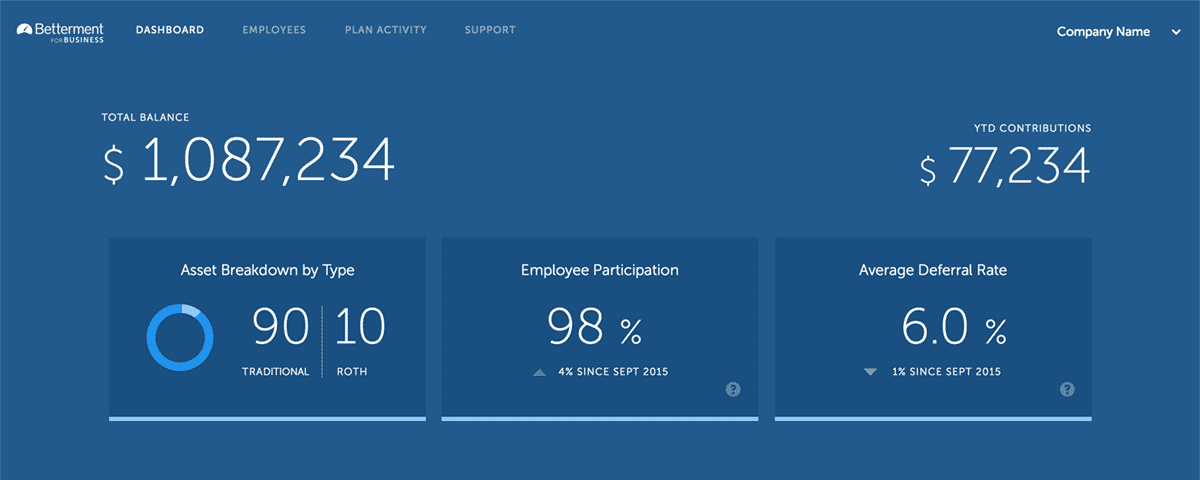
In addition, they have focused on crafting a well designed user interface. In our opinion, this is an area where Betterment at Work shines above more traditional vendors like Principal or John Hancock.
Betterment at Work's 401(k) Cost
Betterment at Work publishes transparent 401(k) pricing online, with three plan options available. The fees include a monthly-base fee and a per-employee fee, both of which are paid by the employer. The employee pays an estimated fund fee and an investment management fee, which are both percentages.
- Essential plan employer fees: $100/month + $5/month per participant
- Pro plan employer fees: $150/month + $6/month per participant
- Essential and Pro plan employee fees: About .06% estimated fund fee and .25% on assets annually for investment management
- Flagship plan: Requires consultation for price estimate
What’s Included in Each Plan?
Each plan offers various benefits and services.
The Essential plan includes:
- Payroll integrations
- 3(38) and 3(16) fiduciary services
- Ongoing support for plan administrators via email and chat
- Webinars and emails for employees that help with setup
The Pro plan includes:
- Everything in the Essential plan
- Plan design features, such as vesting
- Additional support via phone calls
- Additional employee benefits, such as student loan management and 529 education savings
- Financial coaching option to add on
The Flagship plan includes:
- Everything in the Pro plan
- Additional compliance support covering mid-year ADP testing and more
- Dedicated support (non-automated)
- Additional employee benefits, including financial coaching
Betterment at Work's Fiduciary Protection
Betterment at Work will act as a 3(16) administrator fiduciary and a 3(38) investment fiduciary, which may help employers reduce their risk exposure. 3(16) administrator fiduciaries are responsible for certain administrative aspects of the plan, while 3(38) investment fiduciaries are responsible and take legal liability for choosing and monitoring the investment options in the plan.
This relieves the employer of the liability for certain plan administration responsibilities and for choosing appropriate and “decent” funds for the employees, ultimately reducing the amount of work required. In addition, this may also enable the 401(k) plan to have better investment offerings for the employees.
Betterment at Work Alternatives
The best alternatives to Betterment at Work include:
- Human Interest, which offers significant payroll integrations
- Guideline, which charges minimal fees for employees
- Vestwell, which offers greater plan flexibility
- ForUsAll, which targets cost-conscious and fast growing companies
- Employee Fiduciary, which targets small businesses and offers non-automated support
There are also more traditional providers that offer 401(k) administration services to small businesses, such as:
- John Hancock
- Principal
- Fidelity
- Vanguard
Betterment 401(k) Payroll Integrations
Betterment at Work offers many payroll integrations including:
- ADP Workforce Now
- Ascentis
- Ceridian
- Gusto
- Paychex
- Workday
- Rippling
- Zenefits
Keep in mind that not all providers offer payroll integration. Payroll integration is important because administering a 401(k) can be a very manual, time consuming and error prone process, especially for a fast growing business. As the plan sponsor (the company sponsoring/offering the retirement plan), you are responsible for making sure that when employees make changes in payroll they are reflected in the 401(k).
For example, if an employee reduces their savings rate from 10% to 6%, or if they get a raise, the person running the plan is legally required to make sure that the correct amount of money is taken out of the employee’s paycheck and deposited into their retirement account. There can be large penalties for getting this wrong.
Our Experience With Betterment at Work
As an owner who set up a 401(k) for my small business, I like Betterment at Work’s features, especially the flexible plan options and the payroll integration. The ongoing support has always been incredibly thorough and prompt. In addition, the interface is easy and straightforward for the whole team to use, which is a major benefit for a growing business.
The Verdict: Are Rory's products legit for women during menopause?
Betterment at Work offers a robust solution for small businesses to streamline their 401(k) administration.
Betterment at Work has developed advanced, yet easy-to-use software tools that help automate and personalize investment advice to plan participants. Best known as a direct to consumer robo-advisor with billions in Assets Under Management (AUM), Betterment has slowly built their retirement arm and has quietly become a respected 401(k) provider with thousands of small business clients.
If you have a low number of assets in your plan (<$20m), they are likely a very cost-effective solution. Although, if you’re trying to offer retirement benefits to your employees for the first time (i.e. no existing plan in place), then they may not be the best fit.
Frequently Asked Questions (FAQs)
How trustworthy is Betterment?
Betterment is a trustworthy and well-known 401(k) provider that offers services for individuals and businesses.
How does Betterment make money?
Betterment makes money in several ways, including financial advice packages, investment plans, checking accounts, and more.
Does Betterment have high fees?
Betterment at Work’s fees tend to be reasonable, especially when compared to similar competitors.
Methodology
We conduct extensive research to evaluate the pricing, effectiveness, accessibility, overall quality, and user experience of each product we review. This also included examining and comparing them to several alternatives.
Swipe or scroll to view all columns →
| Review Process | Key Metrics | Weighting |
|---|---|---|
| Purchase online | – ease of completing intake form – affordability – upfront commitment or subscription required? – money back guarantee or refund policy? | 1 |
| Shipping + unboxing | – shipping cost – time from order to treatment delivery – sustainable packaging | 1 |
| Testing + journal for 1-3 months | – ease of use – transition into habitual use – taste / smell / feel / pain | 1.5 |
| Results after 3 months of use | – efficacy / results – ease of forming a health habit – requires additional purchase? – responsive customer support – willingness to recommend to a friend | 1.5 |